Shopping Cart
0
Selected especially for you:



Pregnancy and childbirth are characterized by significant anatomical changes that affect the skin. The transformation your body undergoes can be accompanied by symptoms such as itching, rashes, or stretch marks. In this article, we’ll take a closer look at these symptoms and what you can do about them.

Skin problems affecting the entire body are a common issue during pregnancy. In fact, 75% of pregnant women report skin changes and discomfort during pregnancy. Below, we discuss a few of these conditions.
Stretch marks
Many women experience skin problems during pregnancy that are not caused by skin diseases or conditions, but rather by the changes their bodies are undergoing.
The most common complaint is striae distensae, or stretch marks (77.4% of complaints). These are linear scars caused by damage to the skin resulting from significant stretching.

Unfortunately, no effective treatment for this condition has been found to date. Various treatment options have been reported, with mixed results, and are often heavily promoted by product manufacturers.
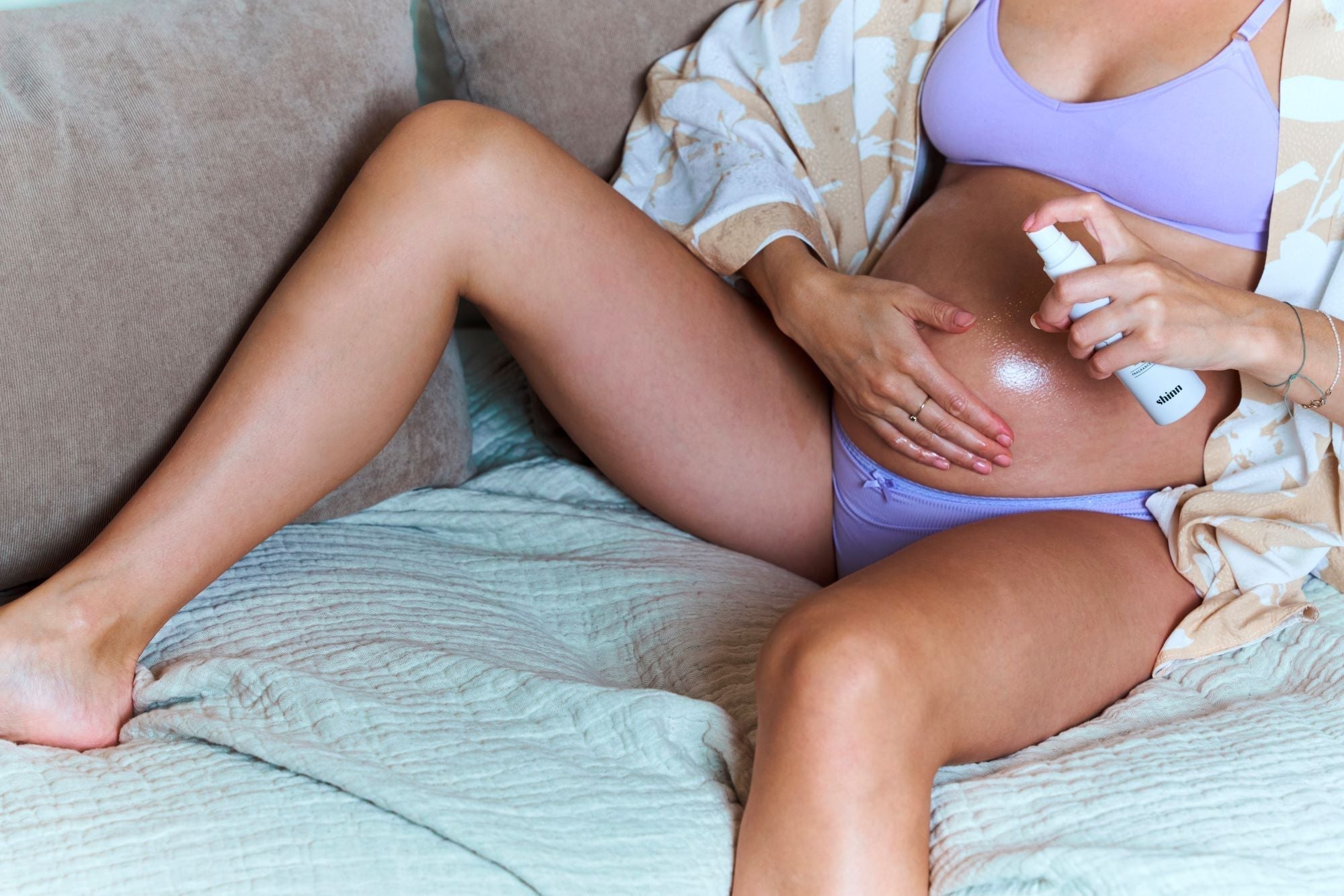
Regular preventive massage of the skin, combined with almond oil, has been shown to have a positive effect. This helps improve the skin’s elasticity and hydration and can significantly reduce the risk of stretch marks.
Eczema
Of all skin conditions that occur during pregnancy, atopic dermatitis, or eczema, is the most common (36%–49%). Although it poses no risk to the mother or child, this condition can cause significant discomfort.
Symptoms usually begin in the first few months of pregnancy and include itchy redness and small, itchy raised bumps under the skin.
For these symptoms, keep the skin well-moisturized and nourish it with an anti-itch and moisturizing cream, lotion, or oil.
Olive oil, castor oil, and plant sterols are ingredients that can help with this.
If symptoms persist, your doctor may prescribe treatment.
Pregnancy cholestasis
Another possible cause of skin problems during pregnancy is intrahepatic cholestasis of pregnancy, a condition in which bile salts build up in the blood.
This condition usually occurs during the third trimester of pregnancy, affects 0.1%–2% of pregnant women, and is not without risk to the fetus.
Skin care creams, lotions, and oils can relieve itching. This should be combined with a doctor-prescribed treatment to lower bile salt levels.
PUPPP and Pemphigoid Gestationis
PUPP and pemphigoid gestationis are pregnancy-related skin conditions; the former is harmless, while the latter poses a greater risk to both mother and child.
PUPP is characterized by severe itching and raised bumps.Pemphigoid gestationiscausesred, itchy patches, vesicles, and/or blisters filled with clear fluid.
Both skin conditions are relatively rare but are still worth mentioning. For example, PUPP occurs in about 1 in 160 pregnancies, and pemphigoid gestationis in 1 in 50,000 pregnancies.
If you have these symptoms, make an appointment with your doctor.
Conclusion
During your pregnancy your body and skin undergo a major transformation. Are you experiencing skin problems? If so, take them seriously and contact your doctor.
Symptoms can have various causes, ranging from harmless to serious. Be sure to follow any prescribed treatment carefully.
If medical treatment isn't appropriate and you want to relieve symptoms such as redness, dryness, itching, and stretch marks, the rich formula ofBody Care Oil canBody Care Oil . Body Care Oil can alsoBody Care Oil relieve Body Care Oil symptoms when used in conjunction with medical treatment.
This gentle, non-irritating formula will moisturize the skin, improve its elasticity, and relieve itching.


Sources
Ciechanowicz P, Sikora M, Taradaj K, Ruta A, Rakowska A, Kociszewska-Najman B, Wielgoś M, Rudnicka L. Skin changes during pregnancy. Is this an important issue for pregnant women? Ginekol Pol. 2018;89(8):449-52. doi: 10.5603/GP.a2018.0077. PMID: 30215465.
Tan EK, Tan EL, "Alterations in physiology and anatomy during pregnancy," Best Practice & Research Clinical Obstetrics and Gynaecology (2013), http://dx.doi.org/10.1016/j.bpobgyn.2013.08.001

In-house gynecologist at Shinncare